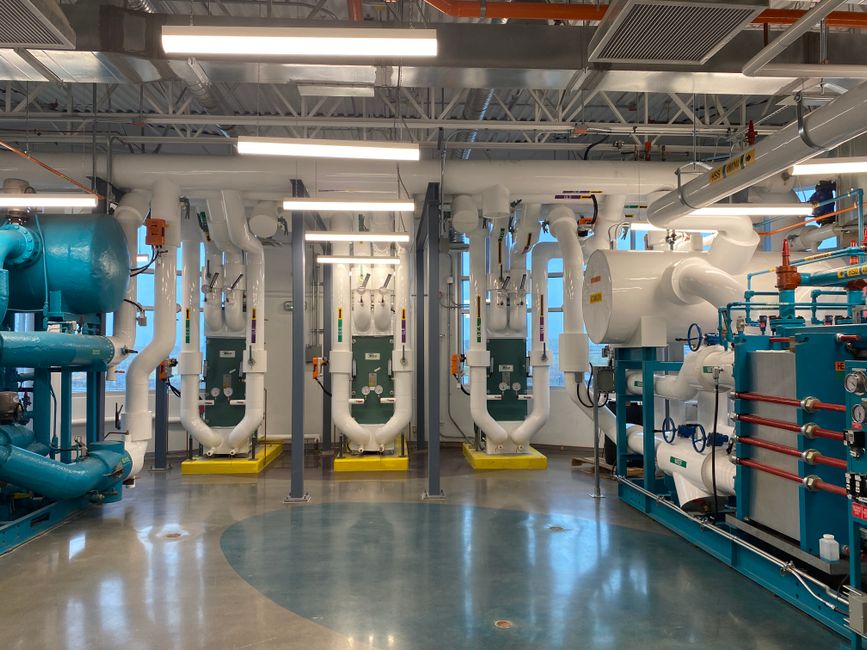
VRF system sizing requires calculating total cooling and heating loads, selecting appropriately-sized outdoor units (typically 100–130% of peak load), and designing zones based on occupancy patterns and thermal requirements. Each indoor unit must match connected space needs while maintaining proper refrigerant distribution. (Related: Heat pump vs electric resistance heating: sizing, efficiency comparison, and cost-benefit calculator for homeowners) (Related: Heat Pump Sizing Guide: Get the Right BTUs Every Time) (Related: Is Two-Stage Cooling Worth It? Complete 2026 Guide) (Related: Mini Split Sizing Calculator: Get the Right BTUs Every Time) (Related: The Complete Guide to AC Unit Nameplate Specifications in 2026) (Related: How to Size a Furnace: Complete 2026 Calculation Guide)
What Is Variable Refrigerant Flow Technology?
Variable refrigerant flow (VRF) systems use inverter-driven compressors to deliver precise amounts of refrigerant to multiple indoor units simultaneously. Unlike conventional split systems that operate at fixed capacities, VRF technology modulates output continuously — matching real-time demand across every zone in the building.
This modulation capability makes VRF a top choice for multi-zone HVAC design in commercial buildings, hotels, schools, and larger residences. Some systems also support simultaneous heating and cooling through heat recovery configurations, where one zone can reject heat that another zone absorbs — a major efficiency advantage during shoulder seasons.
According to the U.S. Department of Energy’s heating and cooling resource, advanced refrigerant-based systems that modulate capacity deliver measurable energy savings compared to conventional on/off HVAC equipment, making proper VRF sizing even more important to realizing those savings.
VRF System Sizing Fundamentals and Load Calculations
Accurate VRF system sizing begins with a room-by-room Manual J load calculation or an equivalent engineering-grade heat load analysis. This quantifies the peak cooling and heating demand for each space, accounting for insulation values, window area, orientation, internal heat gains, and occupancy schedules.
How Do You Calculate the Correct Size for a VRF Outdoor Unit?
The outdoor unit capacity is determined by aggregating all indoor unit loads and applying a diversity factor. In practice, not every zone hits peak demand simultaneously — occupancy patterns, solar orientation, and usage schedules mean total simultaneous demand is typically 70–85% of the sum of all individual zone peaks.
The standard approach for VRF outdoor unit sizing follows this logic:
- Step 1: Complete a room-by-room load calculation for every zone the system will serve.
- Step 2: Sum all individual zone loads to get total connected capacity.
- Step 3: Apply a diversity factor (commonly 0.75–0.85 for commercial applications).
- Step 4: Select an outdoor unit rated at 100–130% of the resulting diversified load.
- Step 5: Verify the selection against manufacturer piping length derating tables, since long refrigerant runs reduce effective capacity.
Most VRF manufacturers allow connected indoor unit capacity to exceed outdoor unit capacity by up to 130%, which is called the connectable ratio. This is intentional — the system is designed to operate below full simultaneous load. Exceeding this ratio, however, leads to inadequate conditioning during peak demand events.
Variable refrigerant flow capacity calculation also needs to account for outdoor design temperatures. A unit rated at 95°F ambient will derate at 105°F, so regional climate data from sources like ASHRAE’s Fundamentals Handbook should inform your design conditions.
Advanced Zoning Strategies for VRF Systems
What Is the Difference Between VRF Zoning and Traditional HVAC Zones?
Traditional HVAC zones control airflow using dampers in a ducted system, modulating how much conditioned air reaches each space. The central air handler, however, still runs at a relatively fixed capacity regardless of how many zones are calling for conditioning.
VRF zoning works differently at a fundamental level. Each indoor unit has its own expansion valve and communicates individually with the outdoor unit’s inverter compressor. This means the system can deliver exactly the refrigerant mass flow required to satisfy each zone — simultaneously and independently — without the pressure imbalances and energy waste common in variable air volume systems.
This architecture enables a level of granularity in multi-zone HVAC design that ducted systems cannot easily replicate. Individual rooms or small clusters of rooms each get their own indoor unit, their own thermostat or controller, and their own refrigerant circuit — all managed through a shared outdoor unit.
Key zoning strategies that improve both comfort and efficiency include:
- Exposure grouping: Cluster zones by solar exposure. South-facing perimeter zones gain heat simultaneously and benefit from being served by the same branch controller.
- Occupancy-based zoning: Conference rooms, break rooms, and other intermittent-use spaces should be zoned separately from continuously occupied offices or patient rooms.
- Heat recovery pairing: In heat recovery VRF configurations, pair interior zones (server rooms, kitchens) that generate consistent heat loads with perimeter zones that need heating — the system transfers that heat directly rather than rejecting it outdoors.
Indoor Unit Selection and Distribution
Indoor unit type selection depends on ceiling height, architectural constraints, and airflow requirements. The primary options include ceiling cassettes (four-way discharge, ideal for open floor plans), ducted fan coils (concealed above ceiling, suited for office corridors), wall-mounted units (residential and small commercial), and floor-mounted units (for spaces with limited ceiling access).
Each indoor unit must be sized to the load of its served space — not oversized. Oversized indoor units short-cycle, pull humidity incompletely, and create temperature swings. The indoor unit’s rated capacity at the system’s operating conditions (not just the nameplate capacity) must meet but not dramatically exceed the zone’s calculated load.
Refrigerant piping distribution also affects performance. Branch selectors or branch circuit controllers connect the outdoor unit to groups of indoor units. Total equivalent pipe length — including vertical rises and fittings — must stay within manufacturer limits, typically 165–300 equivalent feet for the first branch and specified maximums for total system length.
VRF Sizing Calculator Tools and Methods
Manual calculations are a solid foundation, but purpose-built sizing tools dramatically reduce errors and speed up system selection. A structured VRF sizing calculator walks through zone-by-zone load inputs, applies diversity factors automatically, and flags configurations that exceed manufacturer connectable ratios.
For a practical starting point with your own project, use the HVAC Size Calculator at hvacsizecalc.com to establish your baseline heating and cooling loads before moving into VRF-specific outdoor unit and indoor unit selections.
Manufacturer software tools — available from major VRF equipment brands — take those load inputs further by modeling piping configurations, elevation changes, and simultaneous heating/cooling scenarios. Always cross-check software output against manual calculations for any system serving more than four or five zones.
Common VRF Sizing Mistakes to Avoid
- Ignoring piping derating: Long refrigerant lines reduce effective capacity. A system sized perfectly on paper can underperform significantly if piping runs push 250+ equivalent feet without applying manufacturer derating factors.
- Oversizing indoor units: Matching every indoor unit to the absolute worst-case load without diversity consideration leads to short-cycling, poor dehumidification, and premature wear.
- Skipping heat recovery analysis: In buildings with simultaneous interior cooling loads and perimeter heating loads, failing to specify a heat recovery system leaves significant efficiency gains on the table.
- Using rules of thumb instead of load calculations: Square-footage-based estimates are unreliable for VRF design. A conference room with floor-to-ceiling glass has a vastly different load per square footRecommended Resources:
- Kill A Watt Power Meter — Helps measure actual cooling/heating loads and energy consumption for accurate VRF system sizing calculations
- Digital Psychrometer/Thermohygrometer — Essential for measuring indoor humidity and temperature conditions across zones to determine thermal requirements for proper VRF zoning
- HVAC Load Calculation Software (Wrightsoft/ACCA Manual J) — Industry-standard software for calculating precise cooling and heating loads needed for proper VRF outdoor unit sizing
See also: Complete Guide to Humidity Control HVAC Dehumidifiers 2026
See also: Complete HVAC System Commissioning Guide: 7 Steps in 2026
Related: Scroll vs Rotary Compressors: 5 Key Sizing Impacts in 2026
Related: AC Coil Size Guide: Match Every System Correctly (2026)
SPONSORED
Estimating Software Built for HVAC Contractors
ArcSite lets you draw site plans, create estimates, and close jobs faster — all from your phone or tablet. Used by 100,000+ field service professionals.
Try ArcSite Free →Affiliate partner — we may earn a commission at no cost to you.
SPONSORED
Need HVAC Cleaning or Home Services?
Cleanster connects homeowners with vetted cleaning and home service professionals. Book online in minutes.
Book a Service →Affiliate partner — we may earn a commission at no cost to you.