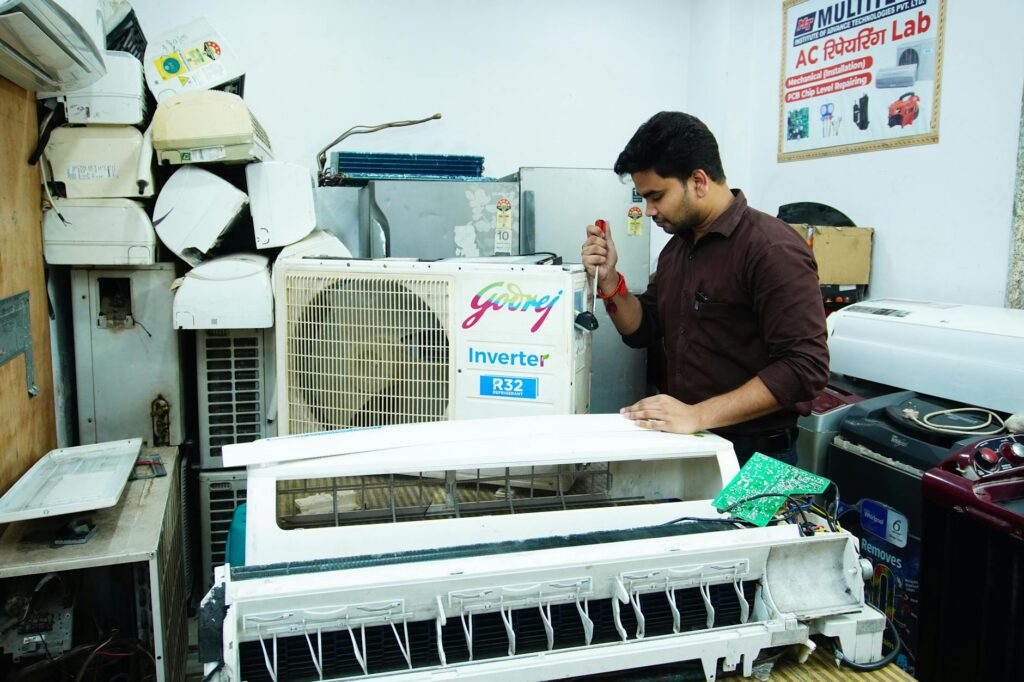
If your air conditioner isn’t cooling your house, the problem usually stems from a clogged filter, low refrigerant, a faulty compressor, or a malfunctioning thermostat. Most homeowners can diagnose and fix common issues in under an hour, but some problems require professional help. This guide walks you through the most common causes and the steps to restore your cooling.
1. Check and Replace Your Air Filter
A dirty air filter is the #1 reason AC systems fail to cool effectively. When the filter clogs with dust, pet hair, and debris, airflow to the evaporator coil decreases dramatically. Your system runs harder, cools less, and wastes energy.
How to fix it:
- Locate your filter (usually in a return air duct or blower compartment)
- Check the MERV rating on the frame—standard filters are MERV 8 to MERV 13
- If it looks gray or brown with visible dust, replace it immediately
- Install a new filter, making sure the airflow arrow points toward the furnace/air handler
- Set a calendar reminder to check filters every 30–90 days, depending on usage and pets
According to the U.S. Department of Energy, a clean air filter can reduce energy consumption by 5–15% and extend AC unit lifespan by years. Replace filters before they become severely clogged to maintain peak performance.
2. Verify Your Thermostat Settings and Battery
More cooling failures are caused by thermostat errors than you’d think. A dead battery, incorrect mode setting, or a faulty sensor can prevent your AC from running at all.
Troubleshooting steps:
- Replace the batteries if your thermostat is wireless or programmable (many use AA or AAA batteries that last 1–2 years)
- Check the mode switch—it must be set to COOL, not HEAT, FAN, or AUTO
- Lower the setpoint at least 3 degrees below the current indoor temperature to trigger the AC to run
- Verify the display shows the correct temperature; if it doesn’t match a wall thermometer, the sensor may be failing
- Test the system after each change—you should hear the compressor kick in within 2–3 minutes
Smart and programmable thermostats may also have scheduling conflicts or app connectivity issues. Review your schedule settings if the unit turns off unexpectedly during the day.
3. Inspect Outdoor Unit Airflow and Refrigerant Lines
Your AC’s outdoor condenser unit must have clear airflow to release heat. Blocked coils, debris, or frozen lines prevent the system from cooling your home.
What to check outside:
- Clear debris around the condenser—leaves, grass clippings, and dirt reduce efficiency by up to 25%, per the EPA
- Trim vegetation at least 2 feet away from all sides of the unit
- Inspect copper refrigerant lines running to your house; they should be cold to the touch and wrapped in foam insulation
- Look for ice buildup on lines or the coil—this indicates low refrigerant or an airflow problem that requires a technician
- Listen for unusual noises like hissing (refrigerant leak) or grinding (compressor damage)
Warning: Do not attempt to recharge refrigerant yourself. The EPA restricts refrigerant handling to certified technicians because these gases are potent greenhouse substances. A licensed professional must diagnose and repair leaks.
How to Use Our AC Sizing Calculator
Not sure if your AC is correctly sized for your space? An oversized or undersized unit struggles to maintain comfort and consumes excess energy. Use our AC Size Calculator to determine the BTU capacity your home needs based on square footage, insulation, climate zone, and ceiling height. Proper sizing ensures even cooling, lower energy bills, and consistent comfort year-round.
Frequently Asked Questions
Why is my AC running but not cooling?
If your compressor cycles on and you hear the unit running but cold air isn’t coming from the vents, the issue is usually low refrigerant, a frozen evaporator coil, or a failed blower motor. A clogged indoor air filter or blocked outdoor condenser also restricts airflow. Check these items first, then call a technician if the problem persists. Never ignore a running AC that doesn’t cool—prolonged operation without proper refrigerant can damage the compressor permanently.
How much does it cost to fix an AC that won’t cool?
Simple fixes like replacing a filter or thermostat battery cost under $50. A refrigerant recharge ranges from $100–$300, while compressor replacement or a full system failure can cost $1,500–$5,000+. The best approach is preventive maintenance: annual inspections by a licensed technician typically cost $75–$200 and catch problems before they become expensive repairs.
Can I fix my AC myself or do I need a professional?
You can safely handle filter replacement, thermostat checks, and outdoor unit cleaning. However, refrigerant work, electrical repairs, and compressor issues require EPA certification and specialized tools. Attempting refrigerant service without proper licensing violates federal law and voids your warranty. Call a qualified HVAC technician for diagnostics and repairs involving sealed components.
When to Call a Professional
Contact an HVAC technician immediately if you notice:
- A hissing or bubbling sound (refrigerant leak)
- Ice on the refrigerant lines or indoor coil
- The compressor won’t start even with corrected thermostat settings
- Temperature swings or uneven cooling across rooms
- A burning smell from the outdoor unit
- Constant cycling on and off every few minutes
A professional can use a pressure gauge to check refrigerant levels, test electrical components, and diagnose compressor or motor failure. Annual maintenance appointments in spring also prevent mid-summer breakdowns and keep your warranty valid.
Final Thoughts
Most AC cooling failures are preventable with routine filter changes, thermostat checks, and outdoor unit maintenance. Start with the simple fixes outlined above, and don’t hesitate to call a licensed technician if basic troubleshooting doesn’t restore your cooling. Prompt attention to AC problems saves money, extends system life, and keeps your home comfortable when you need it most.
- Reusable HVAC Air Filter 16x25x1 — Clogged filters are cited as a primary AC cooling issue; replacement/reusable filters are essential maintenance products for readers troubleshooting their systems
- Digital Smart Thermostat — Post mentions faulty thermostats as a cooling problem; smart thermostats help diagnose temperature control issues and improve HVAC efficiency
- HVAC System Vacuum Pump & Manifold Gauge Set — Useful for DIY diagnosis and maintenance of refrigerant levels and system pressure; helps homeowners identify low refrigerant issues mentioned in the post
Related: Why Is My AC Not Cooling? 7 Fixes That Work
Related: AC Not Cooling? 7 Common Causes and Fixes
Related: Why Your AC Isn’t Cooling: Fixes & Solutions
SPONSORED
Estimating Software Built for HVAC Contractors
ArcSite lets you draw site plans, create estimates, and close jobs faster — all from your phone or tablet. Used by 100,000+ field service professionals.
Try ArcSite Free →Affiliate partner — we may earn a commission at no cost to you.
SPONSORED
Need HVAC Cleaning or Home Services?
Cleanster connects homeowners with vetted cleaning and home service professionals. Book online in minutes.
Book a Service →Affiliate partner — we may earn a commission at no cost to you.